

 강화학습_오일석_10-1.png [59 KB]
 프로그램 10-1 PPO-clip을 이용한 Hopper 과업 학습.txt [9 KB]
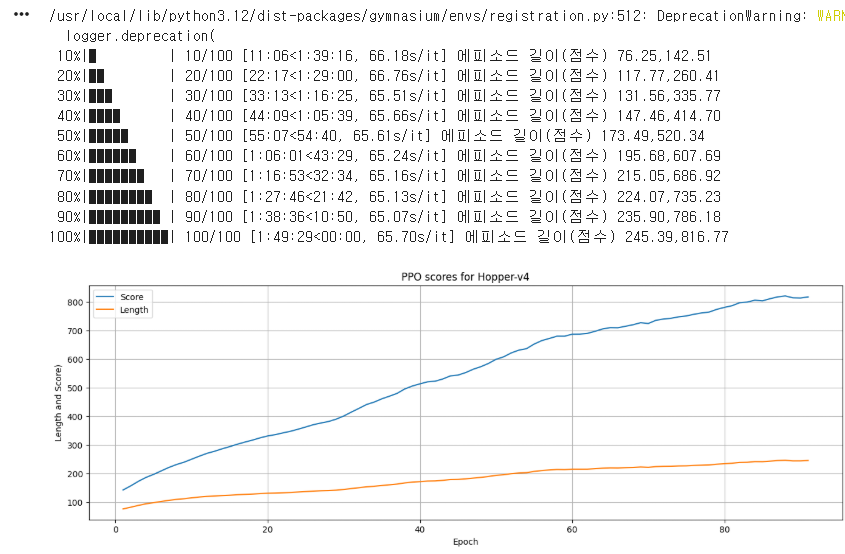
| 1 2 3 4 5 6 7 8 9 10 11 12 13 14 15 16 17 18 19 20 21 22 23 24 25 26 27 28 29 30 31 32 33 34 35 36 37 38 39 40 41 42 43 44 45 46 47 48 49 50 51 52 53 54 55 56 57 58 59 60 61 62 63 64 65 66 67 68 69 70 71 72 73 74 75 76 77 78 79 80 81 82 83 84 85 86 87 88 89 90 91 92 93 94 95 96 97 98 99 100 101 102 103 104 105 106 107 108 109 110 111 112 113 114 115 116 117 118 119 120 121 122 123 124 125 126 127 128 129 130 131 132 133 134 135 136 137 138 139 140 141 142 143 144 145 146 147 148 149 150 151 152 153 154 155 156 157 158 159 160 161 162 163 164 165 166 167 168 169 170 171 172 173 174 175 176 177 178 179 180 181 182 183 184 185 186 187 188 189 190 191 | import gymnasium as gym import numpy as np import scipy import tensorflow as tf from tensorflow.keras.layers import Input, Dense import matplotlib.pyplot as plt import tqdm def discount_cumulation(x, discount): return scipy.signal.lfilter([1], [1, float(-discount)], x[::-1], axis=0)[::-1] class RolloutBuffer: def __init__(self, siz): self.state_mem = np.zeros((siz, s_dim), dtype=np.float32) # 상태 self.action_mem = np.zeros((siz, a_dim), dtype=np.float32) # 행동 self.advantage_mem = np.zeros(siz, dtype=np.float32) # 이익 함수 self.reward_mem = np.zeros(siz, dtype=np.float32) # 보상 self.return_mem = np.zeros(siz, dtype=np.float32) # 이득 self.value_mem = np.zeros(siz, dtype=np.float32) # 가치 함수 self.logprob_mem = np.zeros(siz, dtype=np.float32) # 행동의 로그 확률 self.t_start, self.t_end = 0, 0 def store(self, state, action, reward, value, logprob): self.state_mem[self.t_end] = state self.action_mem[self.t_end] = action self.reward_mem[self.t_end] = reward self.value_mem[self.t_end] = value self.logprob_mem[self.t_end] = logprob self.t_end += 1 def finish_trajectory(self, last_value=0): tslice = slice(self.t_start, self.t_end) rewards = np.append(self.reward_mem[tslice], last_value) values = np.append(self.value_mem[tslice], last_value) deltas = rewards[:-1] + gamma * values[1:] - values[:-1] self.advantage_mem[tslice] = discount_cumulation(deltas, gamma * lamda) # GAE self.return_mem[tslice] = discount_cumulation(rewards, gamma)[:-1] # 이득 self.t_start = self.t_end def get(self): self.t_start, self.t_end = 0, 0 if advantage_normalizing: # 이익 정규화 적용 mean, std = np.mean(self.advantage_mem), np.std(self.advantage_mem) self.advantage_mem = (self.advantage_mem - mean) / std return (self.state_mem,self.action_mem,self.advantage_mem,self.return_mem,self.logprob_mem) class ActorNetwork(tf.keras.Model): def __init__(self): super().__init__() self.actor_mean=tf.keras.Sequential( [Input(shape=(s_dim,)), Dense(64,activation=activation,kernel_initializer=initializer), Dense(64,activation=activation,kernel_initializer=initializer), Dense(a_dim,kernel_initializer=initializer)]) def call(self, state): mean = self.actor_mean(state) return mean def sample_action(self, state, std): # 행동 샘플링 mean = self.call(state) noise = tf.random.normal(shape=mean.shape) action = mean + noise * std return action def log_prob(self, state, action, std): # 가우시안의 로그 mean = self.call(state) log_v1 = -0.5 * tf.square((action - mean) / std) log_v2 = 0.5 * tf.math.log(2.0 * np.pi) + tf.math.log(std) return tf.reduce_sum(log_v1 - log_v2, axis=1) class CriticNetwork(tf.keras.Model): def __init__(self): super().__init__() self.critic = tf.keras.Sequential( [Input(shape=(s_dim,)), Dense(64, activation=activation, kernel_initializer=initializer), Dense(64, activation=activation, kernel_initializer=initializer), Dense(1, kernel_initializer=initializer),]) def call(self, state): return tf.keras.ops.squeeze(self.critic(state), axis=1) @tf.function def learn_actor(states,actions,logprobs,advantages,std): with tf.GradientTape() as tape: logprobs_new=actor.log_prob(states,actions,std) ratio=tf.exp(logprobs_new-logprobs) mins=tf.where(advantages>0,(1+clip_epsilon)*advantages,(1-clip_epsilon)*advantages) loss=-tf.reduce_mean(tf.minimum(ratio*advantages,mins)) if entropy_loss_term: # 엔트로피 적용 entropy=tf.reduce_mean(tf.math.log(std)+0.5*tf.math.log(2.0*np.pi*np.e)) entropy_loss=0.01*entropy loss+=entropy_loss grad=tape.gradient(loss,actor.trainable_variables) optimizer_actor.apply_gradients(zip(grad,actor.trainable_variables)) kl=tf.reduce_mean(logprobs-logprobs_new) # 조기 멈춤에 사용 return kl @tf.function def learn_critic(states, returns): with tf.GradientTape() as tape: values = critic(states) loss = tf.reduce_mean((returns - values) ** 2) grad = tape.gradient(loss, critic.trainable_variables) optimizer_critic.apply_gradients(zip(grad, critic.trainable_variables)) gamma, lamda = 0.99, 0.95 # 할인율, GAE 람다 steps_per_epoch, n_epoch = 4096, 100 # 세대당 반복수, 세대 반복 횟수 actor_lr, critic_lr = 3e-4, 1e-3 # 학습률 actor_iterations, critic_iterations = 80, 80 # 학습 반복 횟수 clip_epsilon = 0.2 # PPO clip 비율(epsilon) target_kl = 0.01 # 조기 멈춤 임곗값 activation = tf.keras.activations.tanh # 활성 함수 std, std_decay, std_min = 0.6065, 0.999, 0.01 # std 스케줄링 시작값과 붕괴율 initializer = tf.keras.initializers.Orthogonal # 가중치 초기화 advantage_normalizing = False # 이익 정규화 여부 actor_early_stopping = False # 조기 멈춤 여부 entropy_loss_term = False # 엔트로피 항 여부 task_name = 'Hopper-v4' env = gym.make(task_name) s_dim = env.observation_space.shape[0] a_dim = env.action_space.shape[0] mem = RolloutBuffer(steps_per_epoch) actor = ActorNetwork() # Add explicit build call for the actor network actor.build(input_shape=(None, s_dim)) critic = CriticNetwork() critic.build(input_shape=(None, s_dim)) optimizer_actor = tf.keras.optimizers.Adam(learning_rate=actor_lr) optimizer_critic = tf.keras.optimizers.Adam(learning_rate=critic_lr) epi_lengths, epi_scores = [], [] length_per_epoch, score_per_epoch = [], [] state, info = env.reset() for epoch in tqdm.tqdm(range(n_epoch)): n_epi, length, score = 0, 0, 0 std = max(std_min, std * std_decay) # std 스케줄링 for t in range(steps_per_epoch): action = actor.sample_action(state.reshape(1, -1), std) logprob_t = actor.log_prob(state.reshape(1, -1), action, std) value_t = critic(state.reshape(1, -1)) state_, reward, terminated, truncated, _ = env.step(action[0].numpy()) mem.store(state,action[0],reward,value_t,logprob_t) state=state_ score+=reward length+=1 if (terminated or truncated) or (t == steps_per_epoch - 1): last_value = 0 if (terminated or truncated) else critic(state.reshape(1, -1)) mem.finish_trajectory(last_value) if terminated or truncated: n_epi += 1 epi_lengths.append(length) epi_scores.append(score) length, score = 0, 0 state, info = env.reset() states, actions, advantages, returns, logprobs = mem.get() for k in range(actor_iterations): # actor 학습 kl = learn_actor(states, actions, logprobs, advantages, std) if actor_early_stopping and kl>1.5*target_kl: # 조기 멈춤 적용 break for k in range(critic_iterations): # critic 학습 learn_critic(states, returns) length_per_epoch.append(np.mean(epi_lengths[-n_epi:])) score_per_epoch.append(np.mean(epi_scores[-n_epi:])) if (epoch + 1) % 10 == 0: print(f' 에피소드 길이(점수) {np.mean(length_per_epoch[-10:]):.2f},{np.mean(score_per_epoch[-10:]):.2f}') actor.save_weights('f10-1.weights.h5') env.close() plt.figure(figsize=(16, 5)) smooth = np.convolve(score_per_epoch, 10 * [0.1], mode='valid') plt.plot(range(1, len(smooth) + 1), smooth) smooth = np.convolve(length_per_epoch, 10 * [0.1], mode='valid') plt.plot(range(1, len(smooth) + 1), smooth) plt.title('PPO scores for ' + task_name) plt.ylabel('Length and Score)') plt.xlabel('Epoch') plt.legend(['Score', 'Length']) plt.grid() plt.show() | cs |
| |||||||||||||||||||||||||||||||||||


 강화학습 실습